
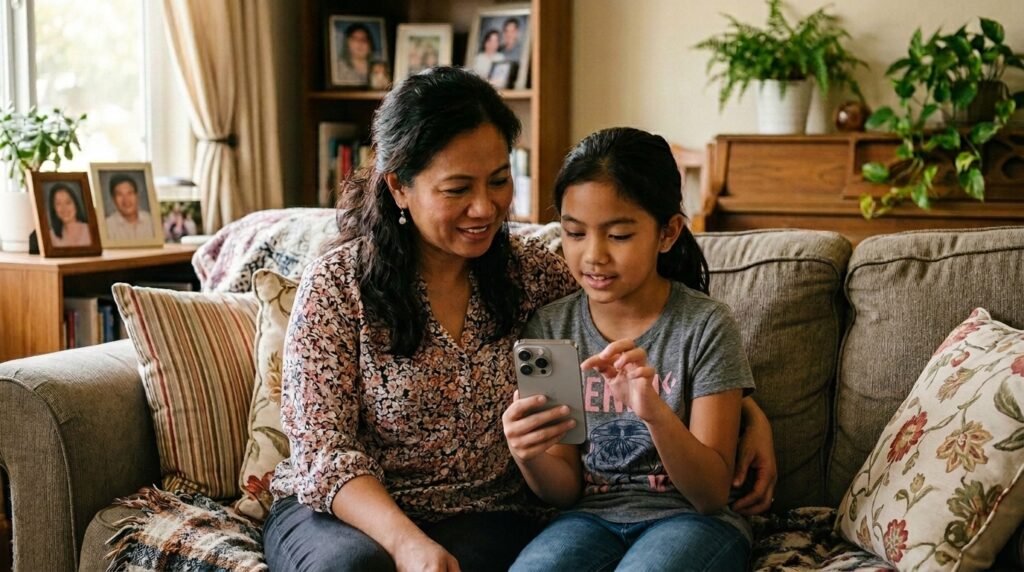
Ito ang tanong na pinipilit ng halos bawat Filipino mom ngayon: “Pwede na bang magkaroon ng sariling social media account ang anak ko?” Maybe your child has been asking for weeks. Maybe their classmates are already on TikTok and Instagram, and your child feels left out. Or maybe you discovered they already made a secret account — and now you are not sure what to do next.
This is one of the most common — and most complicated — parenting decisions of the digital age. There is no single right answer, and any parent who tells you otherwise is oversimplifying a genuinely complex issue. But there is guidance rooted in research, real experience, and a deep understanding of what Filipino children actually face online — and that is exactly what this article is here to offer.
What the Official Age Rules Actually Mean

Let us start with the basics. Most major social media platforms — including Facebook, Instagram, TikTok, and Snapchat — require users to be at least 13 years old to create an account. This rule comes from the Children’s Online Privacy Protection Act (COPPA), a United States law that restricts how companies can collect data from children under 13. It was never designed as a child safety measure — it was designed as a data privacy rule.
This is important to understand because many parents assume that turning 13 automatically makes their child ready for social media. It does not. As Common Sense Media clearly states, thirteen is an arbitrary age — and readiness for social media depends far more on maturity, emotional development, and family context than on a birthday.
Meanwhile, the global conversation around minimum ages is shifting. Australia became the first country in the world to ban social media for children under 16, with its landmark law taking effect in December 2025 — covering platforms like TikTok, Instagram, Facebook, Snapchat, and YouTube. Other countries are following suit. While the Philippines does not yet have a similar law, the international trend reflects a growing scientific consensus: the current age-13 threshold is not protective enough for most children.
What the Research Says About Social Media and Children’s Mental Health
The evidence on social media and children’s well-being is nuanced — and Filipino parents deserve to understand the full picture, not just the alarming headlines.
The Real Risks Are Significant
A comprehensive review published in Healthcare journal (2024) identified a consistent relationship between frequent social media use and mental health challenges in children — including anxiety, depression, sleep disruption, and poor body image. The risks are not uniform across all platforms or all children, but they are real and well-documented.
Research from the American Psychological Association further shows that adolescents who experience online discrimination and hate speech — which is common on major platforms — face increased anxiety and depressive symptoms. For Filipino girls specifically, exposure to unrealistic beauty standards and cyberbullying on image-heavy platforms carries additional risk.
The Benefits Are Also Real
The picture is not entirely dark. A 2025 Pew Research report on teens and social media found that a majority of teens view social media as a positive space for friendships and creativity — and that being excluded from platforms where all their friends connect can have its own social costs. For Filipino children from close-knit communities, social media can genuinely support connection, creativity, and a sense of belonging.
The key, as with most things in parenting, is not whether your child uses social media at all — it is how, when, how much, and with what level of guidance they use it.
A Realistic Age-by-Age Guide for Filipino Parents
Rather than giving a single age cutoff, here is a framework for thinking about social media readiness at different stages of your child’s development.
Under 10 Years Old — Not Yet
Children under 10 are still in a critical stage of social and emotional development. They are building their sense of identity, learning to regulate emotions, and developing the empathy and critical thinking skills they will need to navigate complex social environments. Social media — with its public audiences, comment sections, and comparison culture — is not appropriate for this age group under any circumstances.
This does not mean no screens at all. Video calls with family, educational apps, and supervised YouTube time are very different from independent social media use. The distinction matters.
Ages 10 to 12 — Supervised Exploration Only
Tweens in this range are beginning to feel the social pull of platforms their older peers use. If your child is asking about social media at this age, the best approach is supervised co-use — exploring platforms together, discussing what they see, and helping them build digital literacy before giving them any independent access.
Consider starting with closed, family-only platforms or group chats rather than public accounts. Some Filipino families use a shared family Facebook page or a private group chat on Messenger to give younger children a taste of online interaction in a completely controlled environment.
Ages 13 to 15 — Conditional Access With Strong Rules
This is the age range where the debate becomes most intense — and most personal. Thirteen is the official minimum, but meeting the age requirement is just the starting point. Before saying yes to a social media account at this age, work through the readiness checklist in the next section carefully.
If you do decide to allow access, start with one platform only, set up accounts together, enable all privacy settings, and maintain an open, ongoing conversation about what your child is experiencing online. Spot-checking their account — not secretly, but transparently as an agreed-upon family rule — is appropriate at this stage.
Ages 16 and Up — Greater Independence With Continued Conversation

By 16, most teenagers have developed stronger emotional regulation, better critical thinking skills, and a more stable sense of identity — all of which make navigating social media safer. This does not mean zero parental involvement. It means shifting from monitoring to mentoring — staying connected to what your child is experiencing online while giving them more ownership over their digital life.
The conversation about social media never really ends, even as your child grows. Regular check-ins about how platforms are making them feel, what they are seeing, and who they are talking to remain valuable throughout the teenage years.
Signs Your Child May Be Ready — and Signs They Are Not
Age is one factor. Maturity is another — and in many ways, it is the more important one. Here are the signs to look for on both sides.
Signs of Readiness
- They can follow rules consistently — including turning over devices at night and respecting agreed-upon time limits without constant reminders
- They take responsibility for their actions — rather than blaming others or becoming defensive when they make a mistake
- They come to you when something feels wrong — they have a track record of telling you about difficult situations rather than hiding them
- They understand privacy — they know not to share personal information like their school, address, or daily routine online
- They are emotionally stable — they are not currently going through significant anxiety, depression, or social struggles that social media might worsen
Signs They May Need More Time
- They become easily upset by peer comparisons or social exclusion in real life
- They struggle to put down devices once they have started using them
- They have difficulty understanding consequences — online or offline
- They tend to keep secrets or become defensive when asked about their online activity
- They are currently navigating significant social challenges like bullying or friendship problems at school
No child needs to have every readiness sign in place before you say yes. But if most of the “not ready” signs apply, it is worth waiting — and being honest with your child about why.
Rules to Set Before You Say Yes
Saying yes to social media without a clear set of family agreements in place is one of the most common mistakes parents make. The rules are easier to establish before the account exists than after — when your child already feels entitled to unlimited access.
Set Up the Account Together
Never let your child set up a social media account alone for the first time. Do it together. Walk through every privacy setting — set the account to private, turn off location sharing, disable direct messages from strangers, and review the platform’s reporting tools together so your child knows how to use them.
Agree on Time and Place Rules
Establish clear boundaries around when and where social media can be used — no phones at the dinner table, no social media after 9 PM, no devices in bedrooms overnight. These are not punishments; they are healthy structures that even adults benefit from. Framing them as family rules that everyone follows — including you — makes them far easier for children to accept.
Create a Family Social Media Agreement
A written agreement that both you and your child sign makes expectations concrete and harder to dispute later. Include what platforms are allowed, time limits, privacy rules, what to do if something uncomfortable happens online, and the consequences for breaking the agreement. The Common Sense Media Parents’ Ultimate Guide to Social Media is a reliable, research-backed resource with templates and age-by-age advice you can adapt for your family.
Keep the Conversation Open — Always

The most important rule of all is not about screen time or privacy settings. It is about trust. Make sure your child knows — through your words and your reactions over time — that they can come to you about anything they encounter online without fear of having their device taken away or being judished. The goal is for your child to want to tell you when something goes wrong, not hide it.
What to Do if Your Child Already Has a Secret Account
Discovering that your child made a social media account without your permission can feel like a breach of trust — and it is. But how you respond in that moment matters enormously for your relationship and for their safety going forward.
Stay calm. A reaction driven by anger will shut down communication and push your child further away. Take a breath, and approach the situation with curiosity before consequences. Ask why they felt they needed to do it secretly. Listen to the answer. Understanding the “why” gives you far more useful information than a heated confrontation.
Then address it clearly: explain why the secrecy was the problem, review the account together and assess any safety concerns, and work together to decide whether the account stays (with new rules) or is deactivated. Treat it as a teachable moment, not just a punishable one.
Raising Digitally Smart Children Is a Long Game
The social media question is not a one-time decision. It is an ongoing conversation that evolves as your child grows, as platforms change, and as new risks and opportunities emerge. The Filipino moms who navigate it best are not the ones with the strictest rules or the most lenient ones — they are the ones who stay engaged, stay curious, and keep the lines of communication open.
Your child does not need a perfect digital policy. They need a parent who is paying attention, willing to learn alongside them, and present enough to notice when something is wrong.
If you want to go deeper on protecting your children in the digital space, our article on how to protect your kids from AI online dangers is essential reading alongside this one. And for building the kind of open, trusting relationship that makes these conversations possible in the first place, our guide on mindful parenting and fostering emotional intelligence is where to start.
You do not have to figure this out alone, Mommy. And neither does your child.