
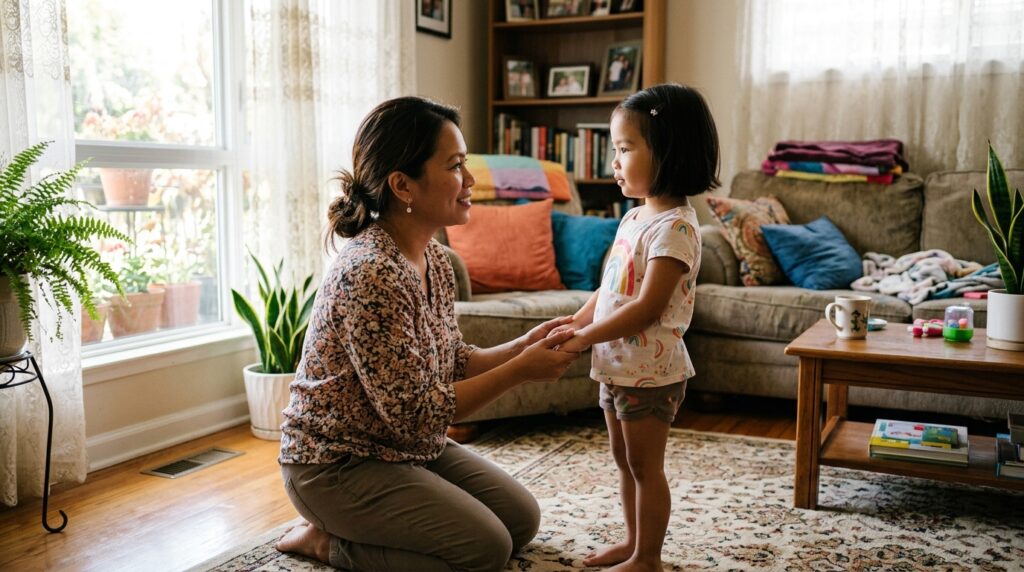
Kung Filipino ka, alam mo na ang ugali. You grew up hearing “Huwag kang makulit,” receiving a pointed look across the dinner table, or feeling the unmistakable whoosh of a tsinelas aimed in your direction. Discipline in Filipino households has always been direct, rooted in deep respect for elders and a strong sense of family hierarchy. It worked for our parents. It worked for their parents before them.
But many Filipino moms today find themselves caught between two worlds — the traditional values they were raised with, and a growing awareness of gentler, more emotionally-led approaches to parenting. They scroll through Facebook and see posts about gentle parenting. They watch reels about validating a child’s feelings. And then Lola walks in and says, “Nag-iiyak na naman ‘yan? Pasayahin mo na.”
The tension is real. And you are not alone in feeling it. This guide is for every Filipino mom who wants to raise emotionally healthy, respectful children without abandoning the values that make Filipino families so beautifully strong.
What Gentle Parenting Actually Means
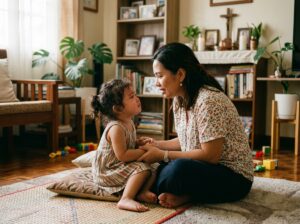
Before we go any further, let us clear up the biggest misconception: gentle parenting is not permissive parenting. It does not mean letting your child do whatever they want, skipping consequences, or allowing disrespect toward elders. That is a misunderstanding that has given gentle parenting an unfair reputation in Filipino parenting circles.
According to research published in PLOS ONE, gentle parenting is an approach that pivots away from discipline-heavy parenting and toward emotional connection. It prioritizes emotion regulation — helping children understand and manage their feelings — while still maintaining clear, consistent boundaries.
Think of it this way: when a child throws a tantrum, an authoritarian response might be “Tumahimik ka na!” with a raised voice or physical discipline. A permissive response might be giving in to stop the crying. A gentle parenting response is different — it acknowledges the child’s feeling first (“I know you’re upset”), sets the boundary clearly (“But hitting is not okay”), and then guides the child toward calmer behavior.
As the University of Connecticut’s parenting resource explains, when a parent shows understanding of a child’s emotions without immediately escalating the situation, it promotes emotional intelligence — which is linked to fewer behavioral problems and higher academic performance later in life.
So gentle parenting is not about being a pushover. It is about being firm and kind at the same time.
Why It Feels Complicated for Filipino Moms
Research has consistently shown that Filipino parenting leans more authoritarian than in many Western contexts — emphasizing obedience, respect for authority, and collective family values over individual expression. As noted in a study on parenting practices in the Philippines, even parents who want to parent differently often find themselves defaulting to the styles they grew up with, especially in moments of stress.
This is not a character flaw. It is human. And in the Filipino context, it is layered with real cultural meaning.
The Weight of Pakikisama and Utang na Loob
Filipino culture is built on deep relational values — pakikisama (getting along harmoniously), utang na loob (debt of gratitude), and a profound respect for elders. These are not things to be discarded. They are among the most beautiful aspects of Filipino family life, and they are values worth passing on to the next generation.
The challenge is that traditional discipline methods — shaming, physical punishment, emotional withdrawal — were often the delivery mechanism for these values. Gentle parenting asks us to keep the values while changing the delivery. You can still teach your child galang (respect) without using fear as the tool.
The Pressure of Judgment From Others
One of the hardest parts of practicing gentle parenting as a Filipino mom is doing it under the watchful eyes of extended family, neighbors, and the broader community. In Filipino culture, how you raise your child is not just a personal matter — it reflects on the entire family. When you choose not to spank, someone may say you are spoiling your child. When you let your toddler cry it out emotionally rather than shutting it down immediately, someone may say you have no control.
This judgment is exhausting. And it is one of the most common reasons Filipino moms quietly abandon gentle parenting approaches even when they believe in them.
The Lola Factor: Navigating Family Disagreements
Let us talk about the elephant in the sala. For many Filipino families, Lola — and by extension, the entire extended family — plays a significant role in raising the children. This is a genuine gift. The love, presence, and wisdom that grandparents bring to Filipino children is irreplaceable.
But it can also create friction when parenting philosophies differ. Here is how to navigate it with grace.
Choose Your Battles Wisely
Not every difference in approach requires a confrontation. If Lola gives your child an extra biscuit or lets them stay up a little later during a visit, that is probably not the hill to plant your flag on. Focus your energy on the things that genuinely matter — the discipline methods that could affect your child’s emotional development and sense of safety.
Have the Conversation Privately and Respectfully
When you do need to address a specific discipline concern — like physical punishment or shaming — do it privately, calmly, and with genuine respect. Never correct Lola in front of the children. Frame the conversation around your child’s specific needs rather than making it a debate about parenting philosophies. Try: “Alam ko na gustong-gusto mo si [child’s name]. Gusto ko lang ibahagi ang napansin ko sa kanya recently…”
Find the Common Ground
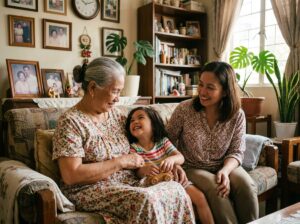
You and Lola want the same thing — a happy, good, respectful child. That shared goal is your foundation. When grandparents see that your gentle approach produces a child who is kind, obedient in the deeper sense, and emotionally grounded, the conversation naturally becomes easier over time. Results speak louder than parenting debates.
Practical Gentle Parenting Strategies for Filipino Families
Gentle parenting is not a rigid script — it is a set of principles you adapt to your own family, your culture, and your child’s unique personality. Here are practical ways to apply it in a Filipino household.
Validate First, Correct Second
When your child is upset, resist the urge to immediately fix, dismiss, or silence the emotion. Instead, name it first: “Galit ka kasi hindi mo nakuha ‘yung gusto mo — gets ko ‘yan.” Once they feel heard, they are far more receptive to your guidance. This does not mean the behavior is acceptable — it means you are separating the feeling from the action.
Give Clear, Calm Instructions — Once
One pattern common in Filipino households is repeating instructions multiple times before any consequence follows — which inadvertently teaches children they have several chances before anything happens. Gentle parenting actually pairs well with clear, firm structure: say the instruction once, in a calm voice, and follow through consistently. No nagging, no escalating — just steady, predictable boundaries.
Use Natural and Logical Consequences
Instead of punishments that feel disconnected from the behavior, use consequences that make sense. If your child refuses to put away their toys, the toys are put away by you and become unavailable for a period. If they are rude to a sibling, they lose the privilege of playing together for a time. These consequences teach cause and effect rather than simply teaching children to fear their parent’s reaction.
Model the Behavior You Want to See
This is one area where Filipino culture and gentle parenting align perfectly. The Filipino value of being a role model — pagiging halimbawa — is central to gentle parenting too. Children learn how to manage emotions, resolve conflict, and treat others primarily by watching the adults around them. When you manage your own frustration calmly, you are teaching your child more than any lecture ever could.
Build in Connection Time Daily
Gentle parenting is most effective when the parent-child relationship has a strong foundation of connection. Even ten to fifteen minutes of genuine one-on-one time each day — reading together, playing, talking without distraction — fills your child’s emotional tank in ways that make them far easier to guide. A connected child is a cooperative child.
What Gentle Parenting Is Not Asking You to Give Up
Let us be clear: gentle parenting does not ask you to raise children who are disrespectful, undisciplined, or disconnected from their Filipino identity. You can practice gentle parenting and still raise children who say “po” and “opo,” who kiss their elders’ hands, who understand the value of hard work and family loyalty.
In fact, children raised with emotional attunement tend to develop stronger empathy, better social skills, and deeper respect for others — not because they were forced into compliance, but because they genuinely understand why these values matter.
The goal is not to erase Filipino culture from your parenting. The goal is to be the best version of a Filipino parent — one who combines the deep love and relational warmth that defines our culture with an emotionally aware, respectful approach to guiding our children.
If you are working on building a stronger emotional connection with your children, our article on mindful parenting and fostering emotional intelligence is a perfect companion to this one.
You Are Already a Good Mom
The fact that you are reading this — thinking carefully about how your words and actions shape your child — already says everything about the kind of mother you are. Gentle parenting is not about being perfect. It is about being present, intentional, and willing to grow.
You will lose your patience. You will raise your voice some days. You will say things you wish you could take back. That is not failure — that is motherhood. What matters is that you repair, you reconnect, and you keep trying.
And on the days when the tsinelas temptation is real and the pressure from all sides feels like too much, be gentle with yourself first. Because you cannot pour from an empty cup. Our guide on how to manage stress and find balance in motherhood is here for exactly those moments.
Kaya mo ‘yan, Mommy.